
How to Choose the Right Forged Flange for Oil & Gas Applications
Choosing a forged flange for oil and gas applications requires more than selecting a size and pressure class. Learn which technical factors engineers and procurement teams should check before sourcing industrial forged flanges.

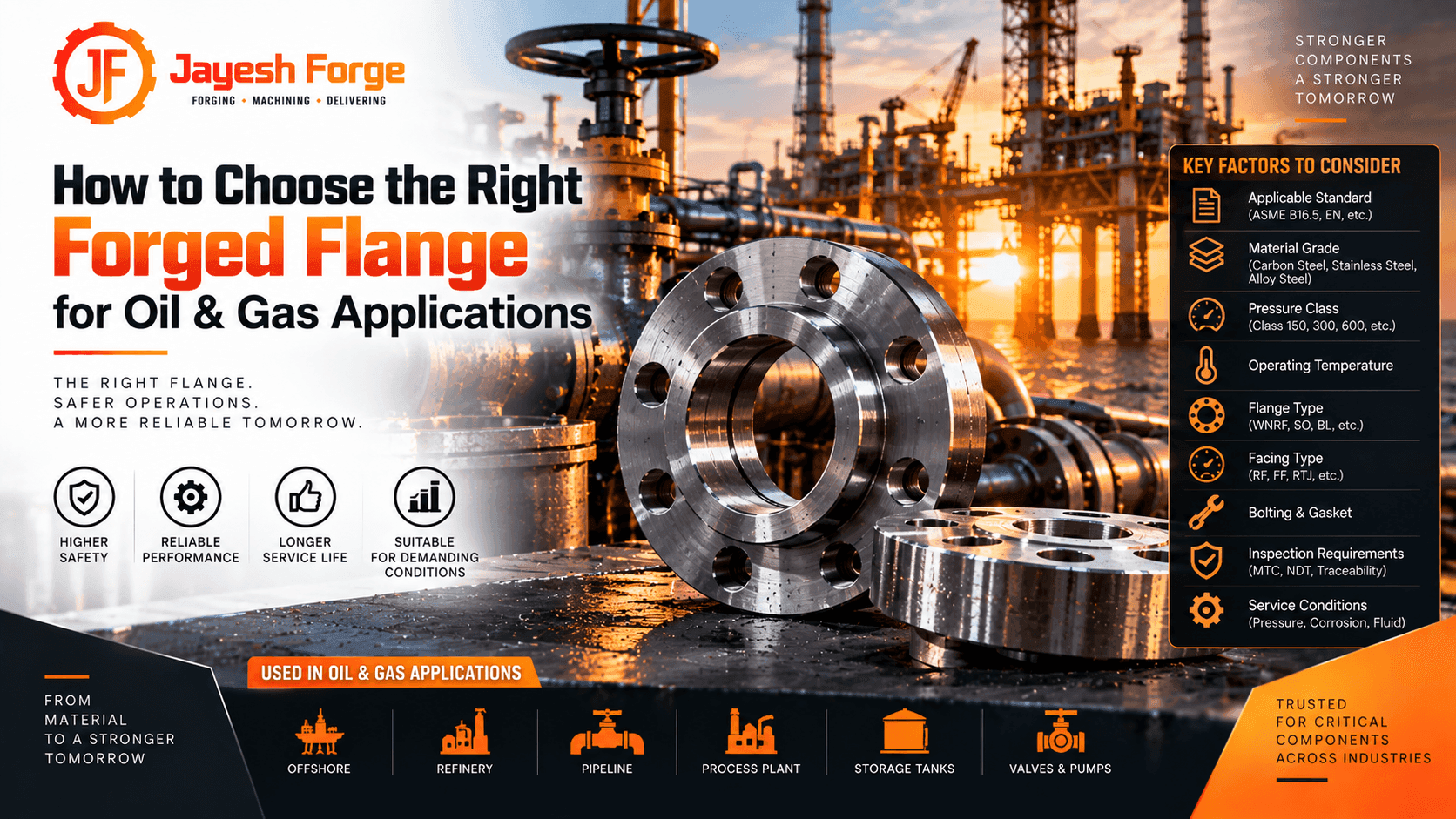
Quick AnswerFeatured
Choosing a forged flange for oil and gas applications requires more than selecting a size and pressure class. Learn which technical factors engineers and procurement teams should check before sourcing industrial forged flanges.
Flanges are critical connection components in many oil and gas piping and equipment systems.
They provide a bolted connection between pipes, valves, pumps, pressure equipment and other components while allowing the system to be assembled, inspected and maintained.
However, selecting the correct flange is not simply a matter of choosing a diameter.
The correct forged flange depends on several technical factors, including:
- Applicable standard
- Material grade
- Pressure rating
- Operating temperature
- Flange type
- Facing type
- Dimensions
- Bolting
- Gasket
- Inspection requirements
- Service conditions
For procurement teams, an incorrect or incomplete flange specification can lead to delays, rework or compatibility problems.
This guide explains the main factors engineers should consider when sourcing forged flanges for oil and gas applications.
Key Takeaways
- Start with the applicable flange standard and drawing, not only the pipe size.
- Material selection should reflect pressure, temperature and service conditions.
- Pressure class is not simply a pressure value in psi and must be evaluated according to the applicable standard and material.
- Flange type, facing, dimensions, bolting and gasket must work together as a complete connection.
- Inspection and traceability requirements should be defined before production, particularly for critical applications.
1. Start With the Applicable Flange Standard
The first step is to identify which standard governs the flange.
Common specifications may include:
- ASME B16.5
- ASME B16.47 for applicable large-diameter flanges
- EN flange standards
- Customer or project-specific specifications
The standard determines important requirements such as:
- Dimensions
- Pressure-temperature ratings
- Materials
- Tolerances
- Facing
- Bolt-hole arrangement
- Marking
- Testing requirements
A supplier should not assume that a flange from one standard can simply be substituted with another.
The complete requirement should be confirmed from the engineering drawing and purchase specification.
2. Select the Correct Material
Oil and gas applications can involve demanding operating environments.
Material selection may depend on:
- Operating pressure
- Temperature
- Corrosion environment
- Fluid characteristics
- Mechanical loading
- Applicable project specification
Common flange materials can include:
- Carbon steel
- Stainless steel
- Alloy steel
- Other materials specified by the application
For example, stainless steel may be selected where corrosion resistance is an important requirement, while carbon or alloy steels may be selected for other service conditions.
The material grade should always be specified rather than simply stating "steel flange."
3. Understand the Pressure Class
Pressure class is an important part of flange selection.
ASME flange systems use Class designations such as:
- Class 150
- Class 300
- Class 600
- Class 900
- Class 1500
- Class 2500
However:
Class 300 does not simply mean 300 psi.
The allowable pressure depends on factors such as material and temperature and must be determined from the applicable standard.
This is particularly important for oil and gas applications where operating conditions can vary significantly.
4. Check Operating Temperature
Temperature should be considered together with pressure.
A flange's pressure-temperature capability can change as operating temperature changes.
Therefore, an RFQ should ideally include:
Design pressure + Design temperature + Material grade + Flange standard
This provides a much stronger technical basis for selecting the correct flange.
5. Choose the Correct Flange Type
Different flange configurations serve different connection requirements.
Weld Neck Flange
A weld neck flange has a long tapered hub and is commonly used in applications where a welded connection and robust flange arrangement are required.
It can be considered for demanding piping and process applications depending on the design.
Blind Flange
A blind flange is used to close a pipe, nozzle or equipment connection.
It can allow a piping section or equipment opening to be isolated.
Slip-On Flange
A slip-on flange is fitted over the pipe and welded according to the applicable design requirements.
It can be used where the relevant design and application permit.
Socket Weld Flange
A socket weld flange uses a socket arrangement for connecting the pipe.
It is used for suitable pipe sizes and applications according to the applicable standard and engineering design.
Threaded Flange
A threaded flange uses a threaded connection rather than a conventional welded connection.
Its use depends on the application, pipe size and applicable engineering requirements.
6. Select the Correct Facing
Flange facing is another important specification.
Common facing types include:
- Raised Face (RF)
- Flat Face (FF)
- Ring Type Joint (RTJ)
The facing must be compatible with the mating flange, gasket and application.
For example, an RTJ arrangement is different from a conventional raised-face bolted connection.
The RFQ should therefore clearly identify the required facing.
7. Flange Size and Dimensions
The nominal pipe size is only one part of flange geometry.
Other dimensions can include:
- Outside diameter
- Flange thickness
- Bore diameter
- Bolt circle diameter
- Number of bolt holes
- Bolt-hole diameter
- Hub dimensions
- Overall length
For standardized flanges, these dimensions are governed by the applicable standard.
For custom or modified flanges, the drawing should clearly define the required dimensions and tolerances.
8. Consider Bolting and Gasket Requirements
A flange is part of a complete connection system.
The connection includes:
Flange + Gasket + Bolting + Mating Component
The correct flange alone does not guarantee a leak-tight connection.
The gasket must be compatible with the flange facing and service conditions.
Bolting must also be suitable for the required temperature, pressure and material/service requirements.
For critical applications, flange, gasket and bolting selection should therefore be evaluated together.
9. Inspection Requirements
Oil and gas projects can have detailed inspection and documentation requirements.
Depending on the specification, inspection may include:
- Chemical analysis
- Mechanical testing
- Hardness testing
- Dimensional inspection
- Visual inspection
- Ultrasonic Testing (UT)
- Magnetic Particle Inspection (MPI)
- Positive Material Identification (PMI), where specified
- Third-party inspection
- Material Test Certificate (MTC)
Not every flange requires every inspection method.
The required inspection scope should come from the drawing, purchase order, project specification and applicable standard.
10. Material Traceability
Traceability is particularly important when multiple flange batches or material heats are being manufactured.
A good traceability system can connect:
Raw Material Heat → Forging Batch → Heat Treatment → Inspection → Finished Flange
Depending on customer requirements, documentation can include:
- Material certificates
- Heat-treatment records
- Chemical analysis
- Mechanical test reports
- Inspection reports
- NDT reports
- Dimensional reports
- Certificate of conformity
The exact documentation package should be agreed before production.
Forged Flange Selection Checklist
| Factor | What to Confirm |
|---|---|
| Standard | ASME / EN / project specification |
| Size | Nominal pipe size |
| Pressure | Required Class or PN |
| Temperature | Design and operating temperature |
| Material | Exact grade and standard |
| Type | Weld neck / blind / slip-on / etc. |
| Facing | RF / FF / RTJ / specified type |
| Dimensions | Standard or drawing dimensions |
| Bolting | Required bolting specification |
| Gasket | Compatible gasket arrangement |
| Heat treatment | Required condition |
| Inspection | Testing and NDT requirements |
| Traceability | Material and batch identification |
| Documentation | MTC and inspection records |
What Information Should You Send to a Flange Manufacturer?
A complete RFQ should ideally include:
- Flange drawing
- Flange standard
- Pressure class / PN rating
- Nominal size
- Material grade
- Flange type
- Facing
- Quantity
- Heat-treatment requirements
- Machining requirements
- Inspection requirements
- NDT requirements
- Marking requirements
- Documentation requirements
- Delivery location
- Required delivery date
If the flange is based on a standard but has customer-specific modifications, clearly mark those modifications on the drawing.
Common Forged Flange Purchasing Mistakes
Mistake 1: Giving Only the Pipe Size
"6-inch flange" is not a complete technical specification.
The standard, rating, material, type and facing are also required.
Mistake 2: Treating Class as PSI
Class numbers should not be interpreted as direct pressure values.
Mistake 3: Ignoring Temperature
Pressure capability must be checked at the relevant temperature.
Mistake 4: Mixing Standards
An ASME flange and an EN flange may have different dimensions, bolt patterns and facing requirements.
Mistake 5: Selecting Material Only by Price
The cheapest material is not necessarily suitable for the service environment.
Mistake 6: Leaving Inspection Until the End
Inspection and documentation requirements should be defined before manufacturing begins.
How Jayesh Forge Approaches Forged Flange Requirements
At Jayesh Forge, forged flange requirements are evaluated according to the component drawing, material grade, dimensions, quantity and inspection requirements.
Our industrial forging capabilities support products including:
- Forged flanges
- Seamless rolled rings
- Gear blanks
- Bushes
- Rings
- Custom industrial forgings
For a new flange requirement, the engineering evaluation can begin with the standard, pressure rating, material grade, flange dimensions, quantity and inspection requirements.
The objective is to establish a manufacturing route appropriate for the customer's actual technical requirement.
Questions to Ask Before Ordering Forged Flanges
Before approving a flange supplier, ask:
- Which standard will be followed?
- What material grade will be supplied?
- What pressure class is required?
- What operating and design temperatures apply?
- Which flange type is required?
- Which facing is required?
- What inspection and NDT are required?
- How will material traceability be maintained?
- What documentation will be supplied?
- Can the supplier meet the required quantity and delivery schedule?
Conclusion
Choosing the right forged flange for an oil and gas application requires more than selecting a diameter and pressure class.
Engineers and procurement teams should evaluate the complete requirement:
Standard + Material + Pressure + Temperature + Size + Flange Type + Facing + Bolting + Gasket + Inspection + Traceability
A complete technical RFQ helps the manufacturer understand the requirement and reduces the risk of incorrect assumptions during production.
For demanding industrial applications, flange selection should always be based on the applicable engineering standard, project specification and actual service conditions.
Looking for Forged Flanges?
Have a flange drawing or oil and gas component requirement?
Share your drawing, standard, material grade, pressure rating, quantity and inspection requirements with Jayesh Forge.
Our engineering team can review your requirement and discuss a suitable forging and manufacturing route.
Frequently Asked Questions
The applicable standard, size, pressure rating, material grade, flange type, facing and inspection requirements are among the most important details.
The appropriate manufacturing process depends on the component specification and application. Forging can provide controlled plastic deformation and is widely used for demanding industrial components, but the correct choice should follow the engineering requirement.
RF means Raised Face, while RTJ means Ring Type Joint. They use different sealing arrangements and must be matched with the appropriate mating flange and gasket/sealing system.
Not automatically. Pressure-temperature ratings depend on the applicable standard, material and temperature. The engineering specification should be checked before selection.
Depending on the project, documentation may include MTC, chemical analysis, mechanical test results, heat-treatment records, dimensional reports, NDT reports and certificates of conformity.
Author
Jayesh Forge Engineering Team shares practical engineering insights on industrial forging, material selection, manufacturing processes, inspection, and quality requirements for engineers, procurement teams, and industrial buyers across global markets.
Submit Technical RFQ
Connect with our metallurgy experts for custom die estimates, material substitution, or seamless rolled ring production.
Request a Forging Quote→