
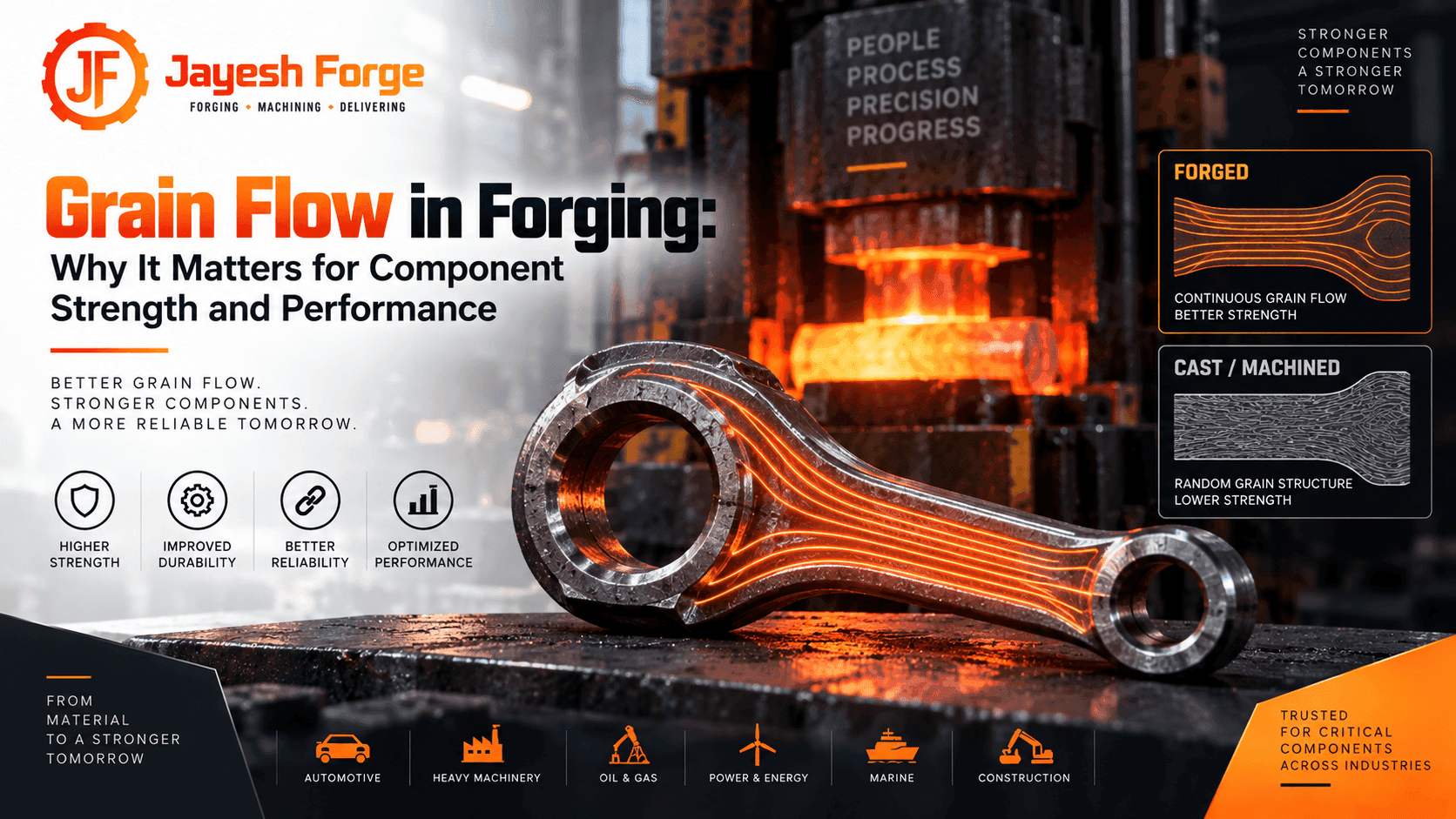
Grain Flow in Forging: Why It Matters for Component Strength and Performance
Grain flow is one of the important characteristics of forged components. Understand how metal deformation influences grain flow and why component geometry, forging direction, reduction, heat treatment and machining must be considered together.

Quick AnswerFeatured
Grain flow is one of the important characteristics of forged components. Understand how metal deformation influences grain flow and why component geometry, forging direction, reduction, heat treatment and machining must be considered together.
Key Takeaways
- Grain flow develops during plastic deformation as the metal is shaped through forging.
- Forging direction matters because the resulting grain orientation can relate to the component's geometry and loading direction.
- Component design and forging process should be considered together, especially for shafts, rings, gear blanks and other load-bearing parts.
- Grain flow alone does not guarantee component performance. Material, heat treatment, reduction and inspection are also important.
- A good forging process starts with the finished component requirement, then works backward to determine the appropriate manufacturing route.
What Is Grain Flow in Forging?
Metals contain grains within their internal microstructure.
During forging, the material undergoes plastic deformation. Instead of remaining in its original arrangement, the grains can become elongated and oriented according to the direction of deformation.
The resulting pattern is commonly called grain flow.
For example, when a cylindrical billet is forged into a shaft, the deformation can produce a grain-flow pattern that follows the general shape and direction of the forged component.
This is different from simply machining a component from a block of material.
The manufacturing process therefore influences not only the external shape but also aspects of the internal structure.
Why Does Grain Flow Matter?
The importance of grain flow depends on the component and its service conditions.
Components may experience:
- Tensile loads
- Compressive loads
- Bending
- Torsion
- Impact
- Cyclic loading
- Pressure
- Wear
When the forging process is properly designed, grain flow can be oriented in a way that is appropriate for the component's geometry and expected loading.
This is one reason forging is widely used for demanding industrial components.
However, it is important to avoid treating grain flow as the only indicator of quality.
A component's final performance depends on the complete manufacturing process.
How Does Forging Change Grain Structure?
The basic principle is straightforward.
Heating → Plastic deformation → Grain elongation/orientation → Heat treatment → Final component
During forging, controlled force is applied while the material is in a suitable temperature range for the selected material and process.
Different forging operations create different deformation patterns.
Common operations include:
- Upsetting
- Drawing
- Cogging
- Fullering
- Edging
- Press forging
- Hammer forging
- Ring rolling
The sequence of these operations affects how the material flows and how the final grain pattern develops.
Grain Flow in Different Forging Components
Different component geometries require different forging approaches.
Shafts
For shafts, the forging process can be designed so that deformation follows the general longitudinal geometry of the component.
This can be particularly relevant for components exposed to bending or torsional loads.
Rings
Ring rolling creates a different deformation pattern from conventional block forging.
The material is progressively reduced and expanded to form the required ring dimensions.
This makes process control important when manufacturing seamless rolled rings for demanding applications.
Gear Blanks
Gear blanks may require controlled forging deformation before machining the final teeth.
The forging route should consider the final geometry, machining allowance and required material properties.
Bushes and Similar Components
For bushes and cylindrical components, the forging route needs to consider the final bore, outside diameter, machining allowance and material flow.
The correct process depends on the component design and production requirements.
Grain Flow vs Machining Direction
One important consideration is that machining removes material from the forged component.
The final machined geometry should therefore be considered when designing the original forging.
For example, if a component contains a critical radius, hole or transition area, the forging process should be designed with the final geometry in mind.
This is why forging and machining should not always be treated as completely separate operations.
A good manufacturing route considers:
Forging shape → Grain flow → Machining allowance → Final geometry
Does Better Grain Flow Always Mean Better Strength?
Not necessarily.
This is an important point when evaluating forged components.
Grain flow is one factor, but final component performance depends on several variables.
These can include:
- Material grade
- Chemical composition
- Forging reduction
- Forging temperature
- Deformation sequence
- Heat treatment
- Final microstructure
- Machining
- Surface condition
- Inspection requirements
For example, two components manufactured from the same nominal material grade can have different properties if their manufacturing and heat-treatment conditions are different.
Therefore, engineers should evaluate the complete material and manufacturing specification rather than using grain flow as the only quality criterion.
Grain Flow and Heat Treatment
Forging and heat treatment are closely related parts of the manufacturing process.
After forging, the component may require a specified heat-treatment condition depending on the material and application.
Possible treatments can include:
- Normalizing
- Annealing
- Quenching
- Tempering
- Solution treatment
The selected treatment depends on the material specification and required properties.
Heat treatment can influence the final microstructure and mechanical properties of the component.
Therefore, a forging specification should clearly define the required material condition and applicable testing requirements.
How Engineers Should Evaluate Grain Flow
When reviewing a forged component, engineers should ask:
1. What loads will the component experience?
Understand whether the component will experience tension, compression, bending, torsion, impact or cyclic loading.
2. What is the final geometry?
The finished component geometry should be considered before deciding the forging shape.
3. What forging process is being used?
Different processes produce different deformation patterns.
4. What material grade is specified?
Material chemistry and grade influence the forging and heat-treatment requirements.
5. What inspection is required?
Depending on the application, inspection may include:
- Chemical analysis
- Tensile testing
- Hardness testing
- Dimensional inspection
- Ultrasonic Testing (UT)
- Magnetic Particle Inspection (MPI)
- Microstructure examination
The inspection plan should be based on the applicable drawing, specification and application requirements.
Forging vs Machining From Bar or Block
One common engineering question is why a component should be forged instead of simply machined from bar or block material.
The answer depends on the component.
For some geometries, machining may be appropriate.
For components where controlled deformation and material flow are important, forging may provide manufacturing advantages.
| Factor | Forging | Machining From Bar/Block |
|---|---|---|
| Material deformation | Controlled plastic deformation | Primarily material removal |
| Grain flow | Can be developed through forging | Depends largely on starting material |
| Material utilization | Can be efficient depending on design | Can involve significant material removal |
| Complex forging shapes | Possible depending on process | Possible but may require extensive machining |
| Production volume | Suitable for repeat production | Depends on component and machining time |
| Tooling | May require forging tooling | Machining fixtures/tools required |
The correct choice should be based on component design, production quantity, material, performance requirements and total manufacturing cost.
Where Is Grain Flow Particularly Relevant?
Grain flow can be an important consideration for components used in industries such as:
Oil & Gas
Pressure-related and mechanical components can require controlled material properties and documented inspection.
Automotive
Components such as shafts, gear blanks, hubs and connecting components can experience repeated mechanical loads.
Wind Energy
Large rings and other structural or rotating components may require carefully controlled manufacturing processes.
Heavy Machinery
Shafts, bushes, rings and other load-bearing components can benefit from a manufacturing route designed around their final service conditions.
Power and Industrial Equipment
Forged components used in demanding mechanical applications may require controlled material properties, heat treatment and inspection.
How Jayesh Forge Approaches Forging Requirements
At Jayesh Forge, the manufacturing process is evaluated according to the component requirement, material specification, geometry and production quantity.
Our capabilities include friction screw press forging and CNC ring rolling, supporting products such as:
- Forged flanges
- Seamless rolled rings
- Gear blanks
- Bushes
- Rings
- Custom industrial forgings
For a new component requirement, the engineering evaluation can begin with the drawing, material grade, quantity, finished dimensions and inspection requirements.
The objective is to establish a manufacturing route that is appropriate for the component rather than treating every forging requirement in the same way.
What Should Be Included in a Forging Drawing or RFQ?
For better technical evaluation, provide:
- Component drawing
- 3D CAD model, if available
- Material grade
- Applicable standard
- Finished dimensions
- Component weight
- Production quantity
- Heat-treatment requirement
- Machining requirement
- Dimensional tolerances
- Inspection requirements
- Testing requirements
- Delivery requirement
This information allows the forging manufacturer to evaluate the component more accurately before production begins.
Further Reading
- Open Die vs Closed Die Forging: Which Process Is Right for Your Component?
- Seamless Rolled Rings vs Welded Rings: What Is the Difference?
Industry Standards & References
- ASME (American Society of Mechanical Engineers)
- ASTM International (Materials & Standards)
- Forging Process Overview
Looking for Custom Forgings?
Have a custom forging requirement?
Share your drawing, material grade, dimensions, quantity and inspection requirements with Jayesh Forge.
Our engineering team can review your requirement and discuss a suitable manufacturing route.
Frequently Asked Questions
Grain flow is the orientation or pattern of the metal's grain structure that develops as the material undergoes plastic deformation during forging.
Grain flow can influence how the material structure relates to component geometry and loading. Its importance depends on the component, material and application.
Forging can provide important manufacturing advantages, but final strength and performance depend on material grade, forging process, reduction, heat treatment, microstructure and other factors.
No. Grain flow describes the orientation or pattern created by deformation, while grain size refers to the size of individual grains within the material structure.
Certain aspects of material structure and process quality can be evaluated using appropriate metallurgical examination and other inspection methods. The required inspection should be defined according to the applicable specification and component requirements.
Author
Jayesh Forge Engineering Team shares practical engineering insights on industrial forging, material selection, manufacturing processes, inspection, and quality requirements for engineers, procurement teams, and industrial buyers across global markets.
Submit Technical RFQ
Connect with our metallurgy experts for custom die estimates, material substitution, or seamless rolled ring production.
Request a Forging Quote→Related Articles
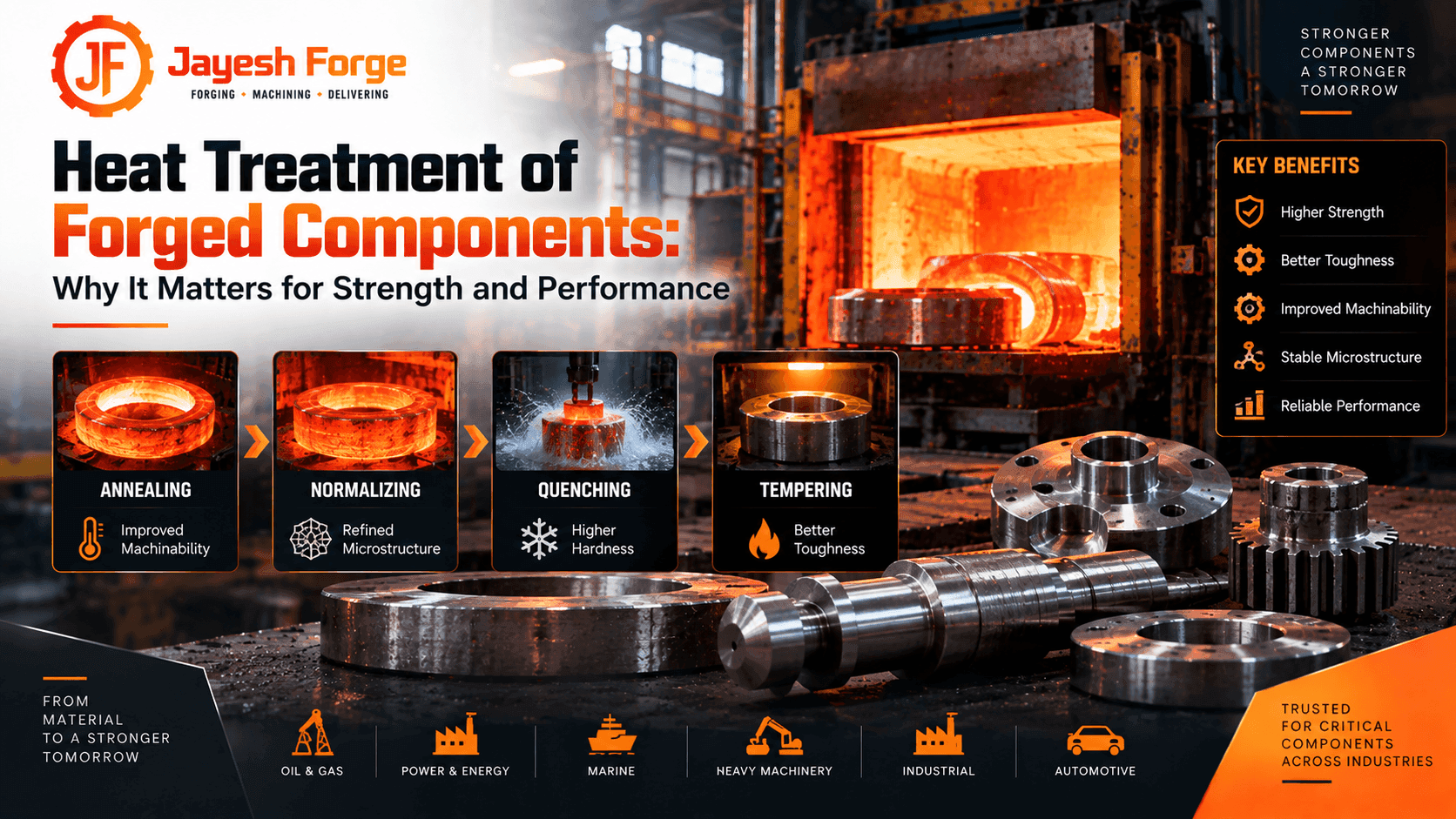
Heat Treatment of Forged Components: Why It Matters for Strength and Performance
Forging creates the component shape, but heat treatment helps achieve the required material condition and mechanical properties. Understand common heat-treatment processes and what engineers should specify when sourcing forged components.
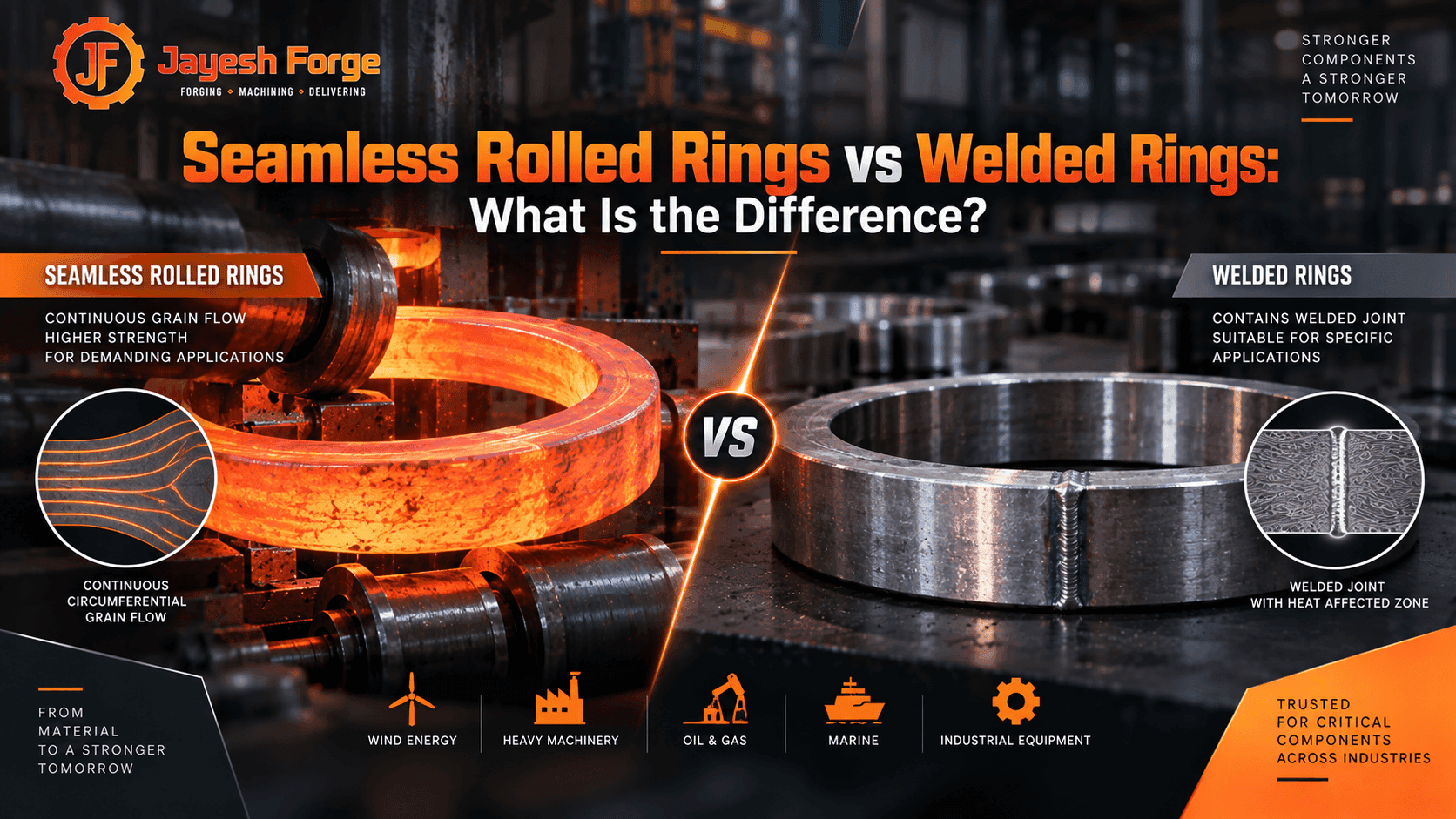
Seamless Rolled Rings vs Welded Rings: What Is the Difference?
Seamless rolled rings and welded rings can look similar after machining, but their manufacturing routes are fundamentally different. Learn how ring rolling, welding, grain flow, inspection and application requirements influence ring selection.