
Heat Treatment of Forged Components: Why It Matters for Strength and Performance
Forging creates the component shape, but heat treatment helps achieve the required material condition and mechanical properties. Understand common heat-treatment processes and what engineers should specify when sourcing forged components.

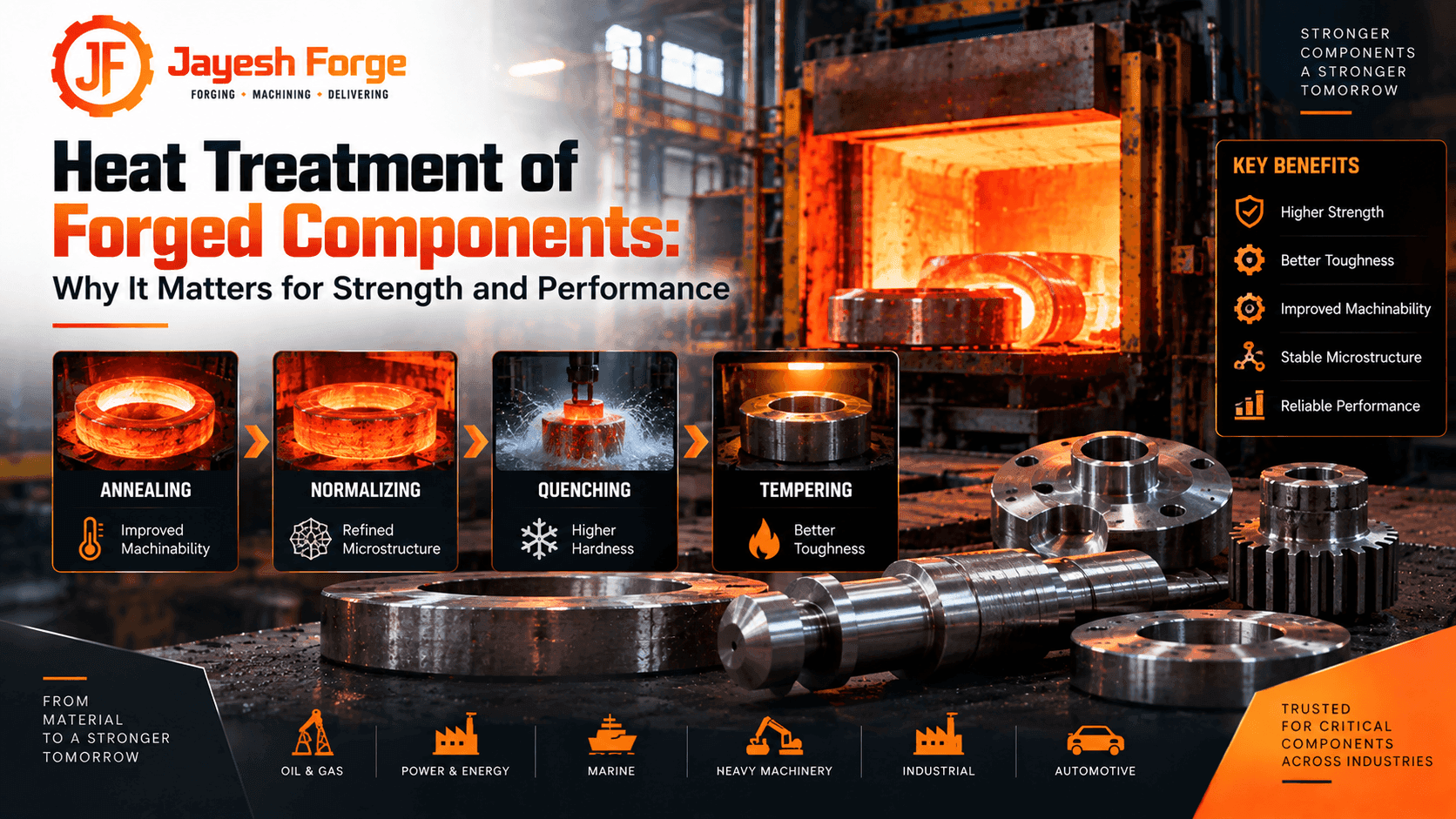
Quick AnswerFeatured
Forging creates the component shape, but heat treatment helps achieve the required material condition and mechanical properties. Understand common heat-treatment processes and what engineers should specify when sourcing forged components.
Forging is an important manufacturing process for producing components with controlled shape and material deformation. However, the forging operation is only one part of the manufacturing route.
For many forged components, heat treatment is an important subsequent process used to achieve the required material condition and mechanical properties.
The appropriate heat-treatment route depends on factors such as:
- Material grade
- Component geometry
- Forging process
- Required mechanical properties
- Hardness
- Toughness
- Machining requirements
- Service conditions
- Applicable specification
For engineers and procurement teams, understanding heat treatment is useful when reviewing forged shafts, rings, gear blanks, flanges, bushes and other industrial components.
Key Takeaways
- Heat treatment can significantly influence the final properties of a forged component.
- Different processes such as annealing, normalizing, quenching and tempering are used for different material and property requirements.
- The correct heat-treatment cycle depends on the material grade, component geometry and required properties.
- Heat treatment should be properly connected to material traceability and inspection documentation.
- A forging RFQ should clearly state the required material condition, mechanical properties, hardness and applicable standard.
What Is Heat Treatment?
Heat treatment is a controlled sequence of heating, holding and cooling used to modify the structure and properties of a metal component.
Unlike forging, which primarily shapes the material through plastic deformation, heat treatment is used to establish the required material condition.
A simplified manufacturing route can look like:
Raw Material → Forging → Heat Treatment → Machining → Inspection → Finished Component
The actual sequence can vary depending on the component and manufacturing specification.
Why Is Heat Treatment Important After Forging?
During forging, the material experiences significant deformation and elevated temperatures.
The final properties of the component depend on how the material is processed after forging as well as on the original material grade.
Heat treatment can be used to achieve requirements related to:
- Hardness
- Strength
- Toughness
- Ductility
- Machinability
- Microstructure
- Dimensional stability
The required properties should always be defined according to the material specification and component application.
Common Heat-Treatment Processes
Different heat-treatment processes are selected for different purposes.
1. Annealing
Annealing generally involves heating the material to a specified temperature followed by controlled cooling.
Depending on the material and annealing method, it can be used to:
- Reduce hardness
- Improve machinability
- Relieve certain internal stresses
- Produce a desired material condition
The exact cycle depends on the material grade and specification.
2. Normalizing
Normalizing involves heating the forged component to a specified temperature followed by cooling under controlled conditions, commonly in air for applicable steels.
It can be used to obtain a more suitable microstructure and mechanical condition following forging.
Normalizing may be specified for various carbon and alloy steel components depending on the applicable material standard.
3. Quenching
Quenching involves heating the material to the required temperature and then cooling it relatively rapidly using a specified cooling medium.
Depending on the material, quenching can produce a harder microstructure.
However, quenching also introduces considerations such as:
- Distortion
- Residual stresses
- Cracking risk
- Cooling uniformity
Therefore, quenching parameters must be controlled according to the material and component geometry.
4. Tempering
Tempering is commonly performed after quenching.
The component is reheated to a controlled temperature and held for a specified period before cooling.
Tempering can be used to adjust the balance between:
- Hardness
- Strength
- Toughness
- Ductility
The final tempering condition should be selected according to the required mechanical properties and material specification.
Quenching and Tempering — Why Are They Used Together?
For many alloy steel components, quenching and tempering are considered together as a heat-treatment route.
The basic concept is:
Austenitizing → Quenching → Tempering
Quenching can increase hardness and strength, while tempering is then used to obtain a more suitable balance of strength and toughness.
The exact temperatures, holding times and cooling conditions depend on the material grade, section size and required properties.
Therefore, a heat-treatment cycle should not be selected simply because it was used successfully for another material.
Heat Treatment and Material Grade
The same heat-treatment process cannot automatically be applied to every steel grade.
For example, alloying elements can influence:
- Transformation behaviour
- Hardenability
- Required treatment temperature
- Cooling response
- Final mechanical properties
This is why the material grade should be clearly identified before the manufacturing process is finalized.
A forging RFQ should specify the exact material designation and applicable standard wherever possible.
Heat Treatment and Component Geometry
Component geometry also matters.
A large ring, thin flange and heavy shaft may respond differently to the same heating and cooling conditions.
Important factors can include:
- Section thickness
- Component diameter
- Geometry
- Weight
- Surface-to-volume ratio
- Cooling conditions
Large sections may require particular attention to temperature uniformity and cooling behaviour.
The heat-treatment process should therefore be designed for the actual component rather than based only on the nominal material grade.
How Does Heat Treatment Affect Machining?
Heat treatment can affect the machinability of a forged component.
Depending on the required material condition, the component may become:
- Easier to machine
- Harder to machine
- More dimensionally stable
- More sensitive to distortion
For this reason, machining and heat treatment should be considered together when planning the complete manufacturing route.
For example:
Forging → Heat Treatment → Rough Machining → Final Heat Treatment → Finish Machining
may be appropriate for some components, while another component may use a different sequence.
The actual route depends on the drawing, material and specification.
Heat Treatment and Inspection
Heat treatment should not be treated as an undocumented production step.
Depending on customer requirements, documentation can include:
- Heat-treatment batch identification
- Furnace temperature records
- Time/temperature records
- Hardness results
- Mechanical test results
- Material Test Certificate
- Traceability records
The required documentation depends on the applicable specification and customer requirements.
For critical industrial components, traceability between the raw material, forging batch, heat-treatment batch and inspection results can be particularly important.
What Mechanical Properties Should Be Checked?
Depending on the material and specification, mechanical testing may include:
Tensile Strength
Measures the maximum stress the material can withstand during tensile loading.
Yield Strength
Indicates the stress level associated with the specified yielding criterion.
Elongation
Provides information about ductility.
Impact Toughness
Where specified, impact testing evaluates the material's behaviour under impact loading at the required test temperature.
Hardness
Hardness testing provides a practical indication of resistance to indentation and can be used as part of material-condition verification.
The required tests should be determined from the applicable material standard, drawing and purchase specification.
Heat Treatment Comparison
| Process | General Purpose | Typical Consideration |
|---|---|---|
| Annealing | Soften or establish a suitable material condition | Can improve machinability |
| Normalizing | Establish a suitable microstructure and material condition | Often used with applicable carbon/alloy steels |
| Quenching | Increase hardness/strength through controlled rapid cooling | Distortion and residual stress must be controlled |
| Tempering | Adjust properties after hardening | Balances strength, hardness and toughness |
| Stress relieving | Reduce certain residual stresses | Applied according to material and component requirements |
These are general process descriptions. The exact heat-treatment cycle must follow the applicable material specification.
What Should Engineers Specify?
When ordering a heat-treated forging, avoid specifying only:
"Heat treated forging."
A better technical requirement includes:
- Material grade
- Applicable material standard
- Required heat-treatment condition
- Required hardness
- Tensile strength
- Yield strength
- Elongation
- Impact requirements, if applicable
- Testing standard
- Inspection requirements
- Documentation requirements
This reduces ambiguity between the customer and forging manufacturer.
Common Heat-Treatment Mistakes
Mistake 1: Using the Same Cycle for Different Materials
Different grades can require different heat-treatment parameters.
Mistake 2: Ignoring Component Size
Section thickness can influence heating and cooling behaviour.
Mistake 3: Specifying Only Hardness
Hardness alone may not define all required mechanical properties.
Mistake 4: Ignoring Traceability
Heat-treatment records should be connected to the relevant material and production batch where required.
Mistake 5: Treating Heat Treatment as Separate From Forging
Forging, heat treatment, machining and inspection should be considered as parts of the complete manufacturing route.
What Information Should You Send for a Heat-Treated Forging RFQ?
For an accurate quotation, provide:
- Component drawing
- Material grade
- Applicable material standard
- Forging weight
- Finished weight
- Production quantity
- Required heat-treatment condition
- Mechanical properties
- Hardness requirement
- Impact requirements, if applicable
- Machining requirements
- Inspection requirements
- NDT requirements
- Documentation requirements
- Delivery schedule
A complete RFQ allows the manufacturer to evaluate the manufacturing route before production begins.
How Jayesh Forge Approaches Forged Component Requirements
At Jayesh Forge, forging requirements are evaluated according to the component drawing, material specification, production quantity and inspection requirements.
Our capabilities include friction screw press forging and CNC ring rolling, supporting products such as:
- Forged flanges
- Seamless rolled rings
- Gear blanks
- Bushes
- Rings
- Custom industrial forgings
For components requiring specific material properties, the required material grade and heat-treatment condition form an important part of the manufacturing evaluation.
The objective is to establish a manufacturing route that considers forging, heat treatment, machining and inspection together.
Heat-Treatment Checklist for Procurement Teams
| Area | What to Confirm |
|---|---|
| Material | Exact grade and standard |
| Heat treatment | Required condition |
| Hardness | Required range |
| Mechanical properties | Tensile, yield, elongation, etc. |
| Impact test | Required or not applicable |
| Furnace records | Required documentation |
| Traceability | Material-to-batch traceability |
| Inspection | Required testing and NDT |
| Machining | Before/after heat treatment |
| Documentation | MTC and heat-treatment records |
Conclusion
Heat treatment is an important part of the manufacturing route for many forged components.
Forging establishes the component shape through controlled deformation, while heat treatment can be used to achieve the required hardness, strength, toughness, ductility and material condition.
The correct heat-treatment process depends on the material grade, component geometry, section size, required properties and applicable specification.
For engineers and procurement teams, the most reliable approach is to specify heat treatment together with the material, mechanical properties, inspection requirements and documentation.
Further Reading
- Grain Flow in Forging: Why It Matters for Component Strength and Performance
- Flange Pressure Ratings Explained: ASME Class vs EN PN Ratings
- Open Die vs Closed Die Forging: Which Process Is Right for Your Component?
- Seamless Rolled Rings vs Welded Rings: What Is the Difference?
Looking for Heat-Treated Forged Components?
Have a forging drawing or material requirement?
Share your drawing, material grade, quantity, heat-treatment condition and inspection requirements with Jayesh Forge.
Our engineering team can review your requirement and discuss the appropriate forging and manufacturing route.
Frequently Asked Questions
Heat treatment can be used to establish the required microstructure and mechanical properties of the forged component, depending on the material and specification.
Not necessarily. The required heat-treatment condition depends on the material, component and applicable specification.
Both can be used to establish a suitable material condition, but they use different heating and cooling approaches and can produce different resulting properties. The appropriate treatment depends on the material and specification.
Tempering is commonly used after quenching to adjust the resulting hardness, strength and toughness to the required level.
Yes. Heat treatment can change hardness and other material characteristics, which can influence machining behaviour.
Author
Jayesh Forge Engineering Team shares practical engineering insights on industrial forging, material selection, manufacturing processes, inspection, and quality requirements for engineers, procurement teams, and industrial buyers across global markets.
Submit Technical RFQ
Connect with our metallurgy experts for custom die estimates, material substitution, or seamless rolled ring production.
Request a Forging Quote→Related Articles
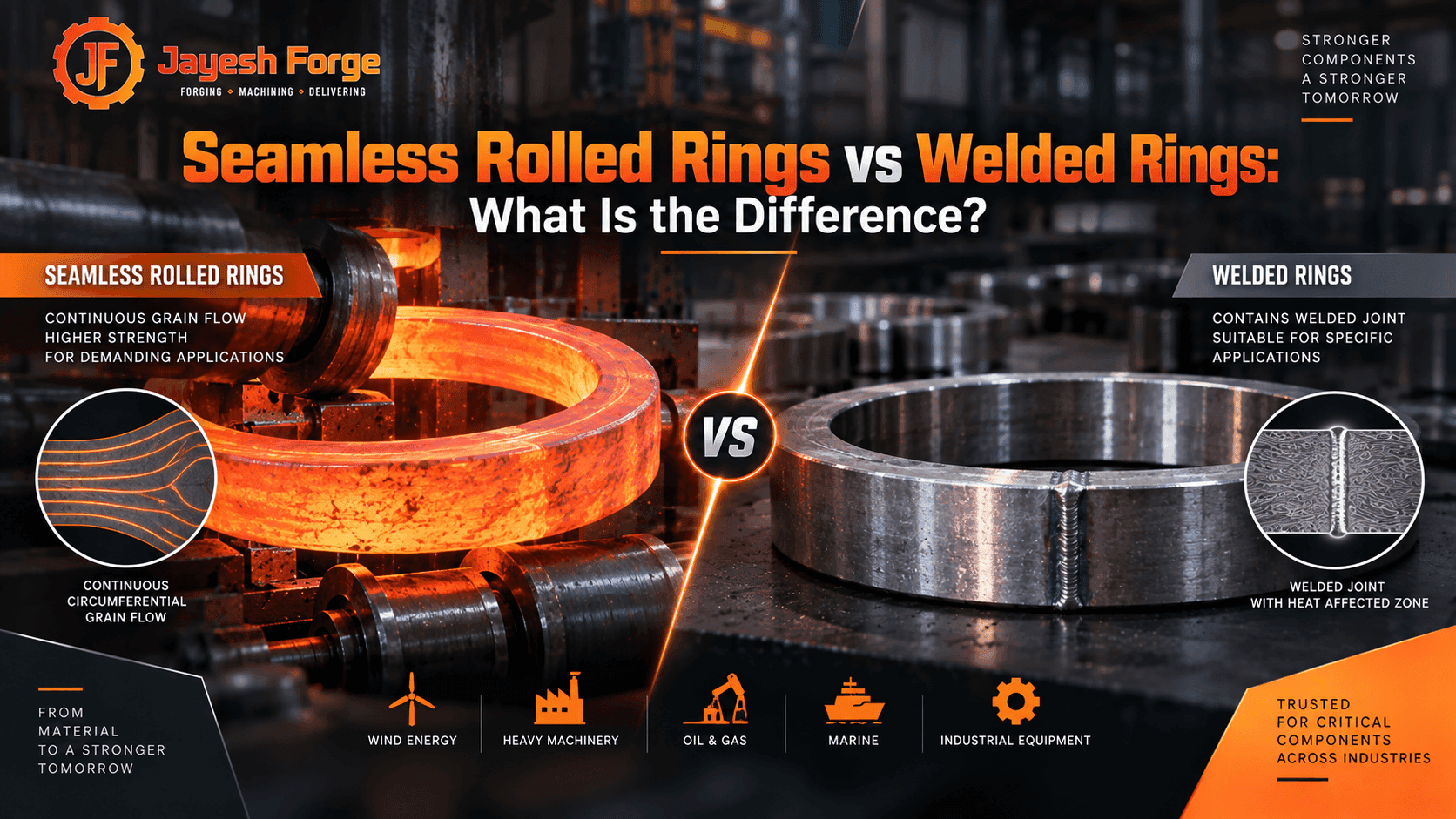
Seamless Rolled Rings vs Welded Rings: What Is the Difference?
Seamless rolled rings and welded rings can look similar after machining, but their manufacturing routes are fundamentally different. Learn how ring rolling, welding, grain flow, inspection and application requirements influence ring selection.
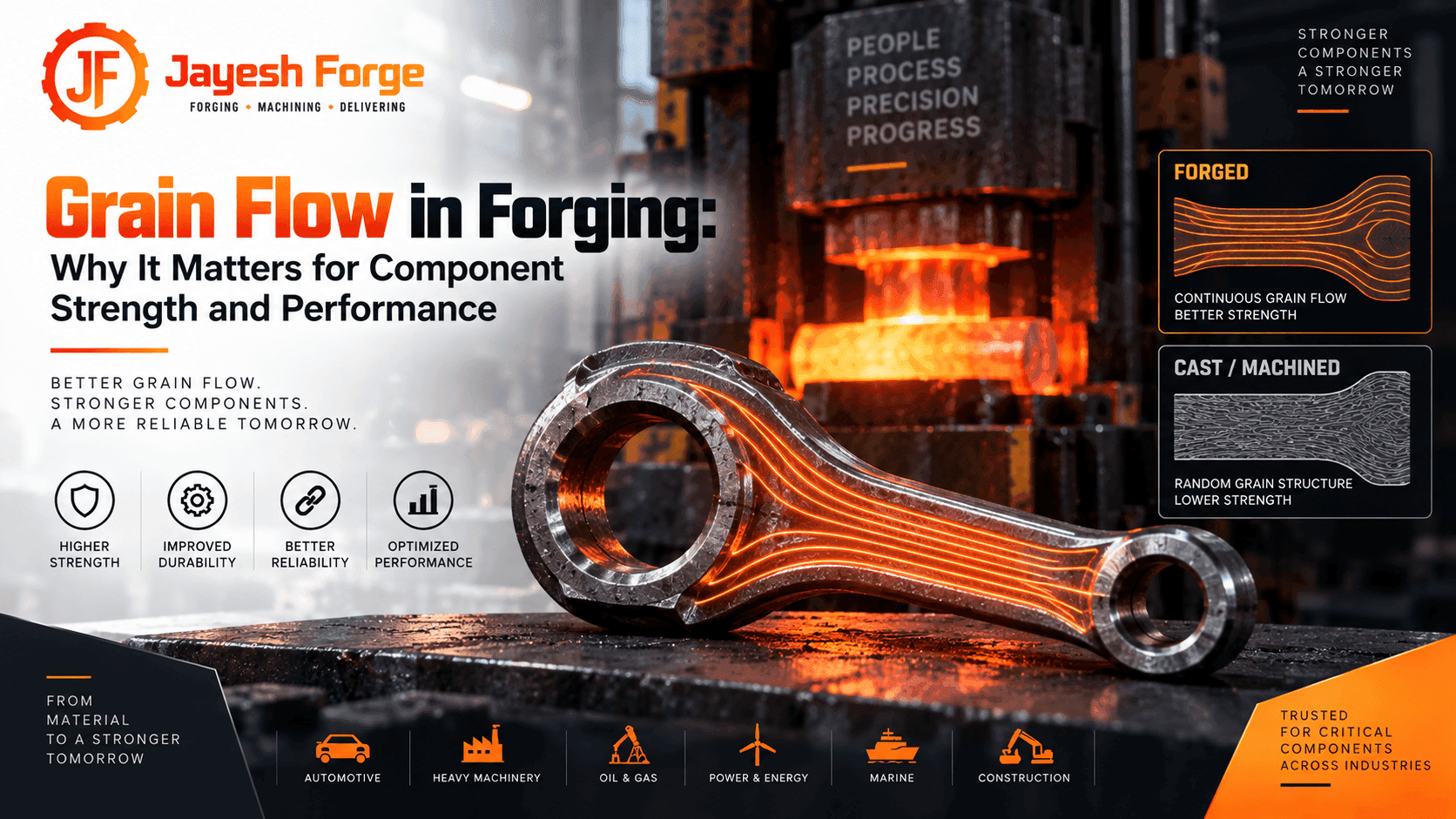
Grain Flow in Forging: Why It Matters for Component Strength and Performance
Grain flow is one of the important characteristics of forged components. Understand how metal deformation influences grain flow and why component geometry, forging direction, reduction, heat treatment and machining must be considered together.