
Flange Pressure Ratings Explained: ASME Class vs EN PN Ratings
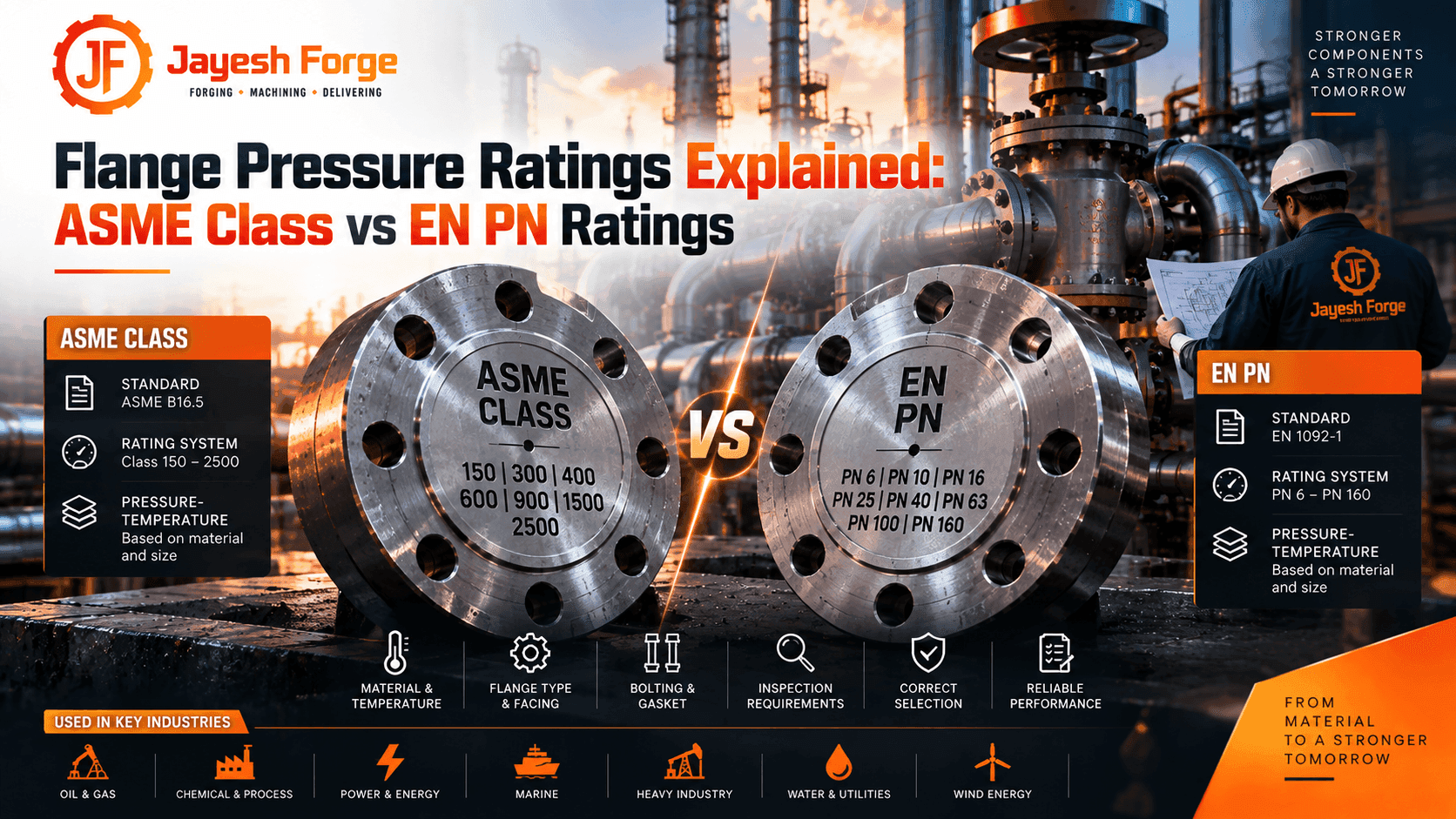
Flange pressure ratings are not determined by pressure alone. Understand the difference between ASME Class and EN PN systems and the role of material, temperature, size, flange type and applicable standards when selecting forged flanges.

Quick AnswerFeatured
Flange pressure ratings are not determined by pressure alone. Understand the difference between ASME Class and EN PN systems and the role of material, temperature, size, flange type and applicable standards when selecting forged flanges.
A flange may look like a relatively simple component, but selecting the correct flange requires more than matching pipe size and nominal pressure.
For engineers and procurement teams, flange selection can involve several parameters:
- Flange standard
- Material grade
- Nominal size
- Pressure rating
- Temperature
- Facing type
- Flange type
- Bolting
- Gasket
- Inspection requirements
Two commonly encountered pressure designation systems are ASME Class and EN PN.
Understanding the difference is important when sourcing forged flanges for oil & gas, chemical, power, process, water, marine and heavy industrial applications.
ASME B16.5 covers pipe flanges and flanged fittings within its specified size and rating scope and includes pressure-temperature ratings, materials, dimensions, tolerances, marking and testing requirements. (ASME)
Key Takeaways
- ASME Class and EN PN are different designation systems and should not be treated as directly interchangeable numbers.
- A flange's allowable pressure depends on factors including material and temperature, not just the nominal rating designation.
- ASME B16.5 covers pipe flanges and flanged fittings within its specified scope, including pressure-temperature ratings and dimensional requirements. (ASME)
- Flange selection should consider the standard, material, size, pressure, temperature, facing, bolting and gasket system together.
- For procurement, the safest approach is to specify the complete flange requirement rather than asking only for a "high-pressure flange."
What Does Flange Pressure Rating Mean?
A flange pressure rating indicates the pressure-temperature capability defined by the applicable standard and material group.
It does not simply mean that a flange marked with a particular rating can withstand the same pressure under every temperature and material condition.
For example, pressure-temperature tables are provided for specific material groups in ASME B16.5. (ASME)
Therefore, engineers should always check the applicable standard and rating table rather than assuming a single pressure value applies universally.
What Is an ASME Class Rating?
In the ASME system, flange ratings are commonly designated using Class numbers, such as:
- Class 150
- Class 300
- Class 400
- Class 600
- Class 900
- Class 1500
- Class 2500
Within the ASME B16.5 scope, these ratings apply to specified flange sizes and configurations. ASME's published overview identifies Classes 150 through 1500 for NPS 1/2 through NPS 24, and Class 2500 for NPS 1/2 through NPS 12. (ASME)
The important point is:
Class 300 does not simply mean 300 psi.
The actual pressure-temperature capability must be determined from the applicable standard, material group, temperature and other requirements.
What Does PN Mean?
The EN system commonly uses PN, or nominal pressure designation.
Examples include:
- PN 6
- PN 10
- PN 16
- PN 25
- PN 40
- PN 63
- PN 100
- PN 160
These designations are used within the applicable European flange standards.
A PN designation should not simply be converted numerically into an ASME Class rating.
For procurement purposes, the complete standard and flange specification should be stated.
ASME Class vs EN PN
| Factor | ASME System | EN System |
|---|---|---|
| Pressure designation | Class | PN |
| Example ratings | Class 150, 300, 600, 900 | PN 10, 16, 25, 40 |
| Common standard | ASME B16.5 within its scope | EN flange standards such as EN 1092-1 |
| Pressure basis | Pressure-temperature rating tables | Rating requirements defined by applicable EN standard |
| Material consideration | Important | Important |
| Temperature consideration | Important | Important |
| Dimensions | Defined by applicable ASME standard | Defined by applicable EN standard |
| Direct numerical conversion | Not recommended | Not recommended |
The designation systems serve similar engineering purposes but are based on different standards and dimensional systems.
Why Can't You Simply Convert Class to PN?
This is one of the most common mistakes in flange purchasing.
For example, it is tempting to create a simple table saying:
- Class 150 = PN X
- Class 300 = PN Y
But this can be misleading.
The actual pressure capability depends on the applicable standard, material, temperature and configuration.
ASME B16.5 itself provides pressure-temperature rating tables for different material groups. (ASME)
Therefore, if a customer drawing specifies:
ASME B16.5 Class 300
the supplier should not replace it with a different PN flange simply because the nominal pressure appears similar.
The dimensional standard, facing, bolt pattern and other requirements also need to match the specified system.
What Factors Affect Flange Pressure Capability?
1. Material
Flanges manufactured from different materials can have different allowable pressure-temperature ratings.
Common forged flange materials include:
- Carbon steel
- Stainless steel
- Alloy steel
- Other materials specified by the application
The exact material must be selected according to the applicable standard and service requirements.
2. Temperature
Temperature can significantly affect allowable pressure.
This is why pressure-temperature rating tables are used instead of relying on one fixed pressure value.
A flange suitable for a particular pressure at one temperature may have a different allowable pressure at another temperature.
3. Nominal Size
The flange size is also important.
ASME B16.5 covers specified nominal pipe sizes and provides dimensional and rating requirements within its scope. (ASME)
Larger-diameter flange requirements may fall under other standards, such as ASME B16.47 for large-diameter steel flanges. (ASME)
4. Flange Type
Common flange types include:
- Weld neck
- Slip-on
- Blind
- Socket weld
- Threaded
- Lap joint
The appropriate type depends on the piping system, connection method and engineering requirement.
5. Facing Type
The flange facing must also match the intended connection.
Examples include:
- Raised Face (RF)
- Flat Face (FF)
- Ring Type Joint (RTJ)
ASME training material specifically identifies these as common flange facing types. (ASME)
Why Are Bolts and Gaskets Important?
A flange does not operate independently.
A bolted flange connection is a system consisting of:
Flange + Bolts + Gasket + Pipe/Equipment
The purpose is to create and maintain a leak-tight connection under the required service conditions.
ASME's flange-joint guidance notes that flange, bolt and gasket behavior interact in achieving a leak-tight joint. (ASME)
Therefore, selecting a flange rating without considering the complete joint can lead to an incomplete engineering evaluation.
Common Forged Flange Types
Weld Neck Flanges
Weld neck flanges are commonly used where a welded connection and robust flange arrangement are required.
Blind Flanges
Blind flanges are used to close the end of piping, equipment nozzles or other connections.
Slip-On Flanges
Slip-on flanges are installed over the pipe and welded into position according to the applicable design and installation requirements.
Socket Weld Flanges
These use a socket arrangement for pipe connection and are used in applications where the applicable standard and design permit.
Threaded Flanges
Threaded flanges connect to threaded pipe without requiring a conventional butt-weld connection.
The appropriate flange type should always be selected according to the piping design and applicable standard.
What Should You Check on a Flange Drawing?
Before manufacturing or purchasing a flange, check:
- Flange standard
- Pressure class / PN rating
- Nominal pipe size
- Material grade
- Flange type
- Facing type
- Outside diameter
- Bore diameter
- Flange thickness
- Bolt circle diameter
- Number of bolt holes
- Bolt-hole diameter
- Overall dimensions
- Heat-treatment requirement
- Inspection requirements
- Marking requirements
This information helps prevent errors during quotation and manufacturing.
What Inspection Is Required for Forged Flanges?
Inspection depends on the component specification and application.
Possible requirements include:
- Chemical analysis
- Mechanical testing
- Hardness testing
- Dimensional inspection
- Visual inspection
- Ultrasonic Testing (UT)
- Magnetic Particle Inspection (MPI)
- Third-party inspection
- Material Test Certificate (MTC)
Not every flange requires every inspection method.
The purchase order, drawing, applicable standard and customer specification should define the required inspection scope.
Common Flange Purchasing Mistakes
Mistake 1: Treating Class as PSI
Class 300 does not simply mean 300 psi.
Always refer to the applicable pressure-temperature rating information.
Mistake 2: Mixing ASME and EN Dimensions
A flange should not be selected only because the pressure designation appears similar.
Bolt pattern, dimensions, facing and other requirements can differ between standards.
Mistake 3: Ignoring Temperature
Pressure capability must be evaluated at the relevant operating temperature.
Mistake 4: Specifying Only the Material
Saying "SS flange" or "carbon steel flange" is not enough for a technical RFQ.
The standard, rating, size, type and facing should also be defined.
Mistake 5: Ignoring the Complete Joint
Flange, gasket and bolting requirements should be considered together.
What Information Should You Send for a Flange RFQ?
For an accurate quotation, provide:
- Flange drawing
- Flange standard
- ASME Class or EN PN rating
- Nominal size
- Material grade
- Flange type
- Facing type
- Quantity
- Heat-treatment requirements
- Machining requirements
- Inspection requirements
- Testing requirements
- Marking requirements
- Delivery location
- Required delivery schedule
A complete RFQ reduces assumptions and helps the manufacturer quote the correct product.
How Jayesh Forge Approaches Forged Flange Requirements
At Jayesh Forge, forged flange requirements are evaluated according to the component drawing, material specification, dimensions, quantity and inspection requirements.
Our industrial forging capabilities support products including:
- Forged flanges
- Seamless rolled rings
- Gear blanks
- Bushes
- Rings
- Custom industrial forgings
For a flange requirement, the engineering evaluation can begin with the standard, pressure rating, material grade, dimensions and inspection requirements.
The objective is to establish the appropriate manufacturing route and provide a quotation based on the actual technical requirement.
Flange Selection Checklist
Before finalizing a flange supplier, confirm:
| Check | Requirement |
|---|---|
| Standard | ASME / EN / specified customer standard |
| Rating | Class / PN |
| Size | Nominal pipe size |
| Material | Required grade |
| Type | Weld neck / blind / slip-on / etc. |
| Facing | RF / FF / RTJ / specified type |
| Dimensions | Drawing or standard dimensions |
| Heat treatment | As specified |
| Inspection | Required testing and NDT |
| Documentation | MTC and inspection records |
| Quantity | Required batch quantity |
| Delivery | Required schedule |
Conclusion
Flange pressure rating is more than a number stamped on a component.
When selecting a forged flange, engineers and procurement teams should consider the standard, rating system, material, temperature, size, flange type, facing, bolting, gasket and inspection requirements together.
ASME Class and EN PN designations should also be treated as part of their respective standards rather than as simple numerical equivalents.
A complete technical specification gives the forging manufacturer the information needed to evaluate the correct manufacturing route and quotation.
Looking for Forged Flanges?
Have a flange drawing or RFQ requirement?
Share your flange standard, rating, material grade, size, quantity and inspection requirements with Jayesh Forge.
Our engineering team can review your requirement and discuss the appropriate forging and manufacturing route.
Further Reading
Frequently Asked Questions
No. ASME Class designations should not be interpreted as a direct pressure value in psi. The allowable pressure depends on the applicable pressure-temperature rating information, including material and temperature. (ASME)
Class and PN are pressure-rating designation systems used within different standards. They should not be treated as simple numerical equivalents.
ASME B16.5 covers pipe flanges and flanged fittings within its specified scope, including pressure-temperature ratings, materials, dimensions, tolerances, marking and testing. (ASME)
At minimum, provide the applicable standard, rating, nominal size, material grade, flange type, facing, quantity and inspection requirements.
Yes. Pressure-temperature ratings are associated with specified material groups and temperatures, so the material cannot be separated from the rating evaluation. (ASME)
Author
Jayesh Forge Engineering Team shares practical engineering insights on industrial forging, material selection, manufacturing processes, inspection, and quality requirements for engineers, procurement teams, and industrial buyers across global markets.
Submit Technical RFQ
Connect with our metallurgy experts for custom die estimates, material substitution, or seamless rolled ring production.
Request a Forging Quote→